
Not every business that wants a mobile app actually needs one. And not every company that calls itself a developer can build one that survives past the first update. This guide walks through both — how to decide if an app is the right move, and what separates capable app development companies from ones that will cost you a rebuild in a year.
At Evergrow Digital Solutions, we work with businesses at both stages: the ones still deciding whether they need an app, and the ones ready to build one. If a website turns out to be the better fit for your case, our guide on custom web development services covers that route instead.
Does your business actually need an app, or is a website enough?
Ask this before spending a rupee on development: will your users open this app more than once?
Plenty of businesses build an app because it feels like the obvious next step, only to watch it sit untouched on a customer’s phone for a few weeks before getting deleted. That’s rarely a technology failure — it’s usually a fit problem.
A website tends to work better when:
- The interaction is a one-time or occasional task — booking, browsing, a single purchase, filling a form
- Users would rather search on Google, land, and finish the task than install something first
- There’s no ongoing need to notify or re-engage the same user regularly
An app earns its cost when:
- Users return often enough that a home-screen icon actually saves them time — daily bookings, order tracking, loyalty programs
- The experience depends on offline access, camera, GPS, or other device-level features
- Push notifications genuinely add value instead of becoming another thing to mute
- The relationship with the user is repeated and habitual, not a one-off transaction
Most people resist installing another app. They’d rather search, find, and move on — which is exactly why a fast, mobile-friendly website often outperforms an app nobody reopens. We ask about actual user behavior before recommending anything. If a website solves it better, that’s what we’ll say — a mismatched app is money spent with no return.
According to industry reports, mobile applications account for a significant share of digital engagement across ecommerce, finance, healthcare, and on-demand services. Businesses increasingly invest in mobile experiences to improve customer retention, streamline daily operations, and open up additional revenue channels — but only when the app fits how customers already behave.
What a custom app development company actually does
A custom app development company builds around your specific business logic, not a template or a no-code assembly kit.
The gap shows up quickly in practice. A healthcare provider needs secure patient records and appointment scheduling. An ecommerce brand needs live inventory sync and in-app payments. A logistics company needs real-time tracking and driver coordination. A SaaS product needs a mobile companion tied to its web dashboard.
None of that comes out of a template. It requires software engineered around the actual workflow — which is the core job of custom app development services.
Template apps vs custom-built apps
| Feature | Template / no-code apps | Custom-built apps |
|---|---|---|
| Scalability | Limited past a certain user base | Built to grow with your business |
| Performance | Moderate, depends on the platform | Optimized for your specific use case |
| Security | Basic, platform-dependent | Advanced, built to your requirements |
| Integrations | Limited to what the builder supports | Connects to any CRM, ERP, or payment system |
| Custom features | Restricted to available blocks | Unlimited, built around your workflow |
| Long-term growth | Difficult once you outgrow the platform | Designed for expansion from the start |
Types of mobile apps we build
Most app development companies offer a narrow slice of this list — we cover the full range under one team.
By platform
- Cross-platform mobile app development — one codebase (React Native, Flutter) running on iOS and Android, faster and cheaper to maintain
- Native cell phone app development — built specifically for iOS or Android for maximum performance and device access
- React Native app development — native-like performance from a single shared codebase
By business need
- Custom app development — built entirely around your workflow, not a template
- Custom ecommerce applications — mobile shopping apps with inventory sync, payments, and order tracking
- Custom enterprise software development — internal tools for managing operations, teams, and data at scale
- Custom web application development — browser-based software that behaves like an app, not just a site
- Banking and fintech applications — secure apps for transactions and account management, built with compliance in mind
By function
- Multitasking apps — handling multiple user workflows in a single interface
- Daily fitness and health tracking apps — logging activity, monitoring progress, sending reminders
- AI-powered app development — recommendations, chatbots, and predictive automation built in
- Device and machine-operating applications — apps that connect to and control external hardware
- Device testing simulators — emulator-based tools that check app performance across screen sizes and OS versions before real users ever see it
Common mistakes businesses make when hiring app development companies
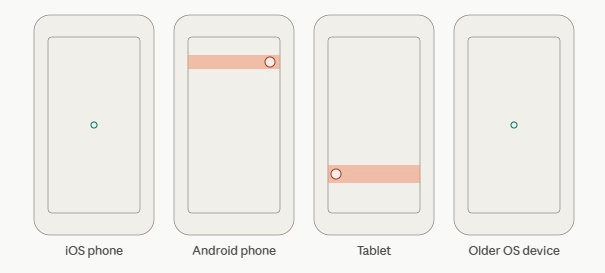
When businesses skip proper research before hiring a custom app development company, most app failures trace back to decisions made before development even started
- Choosing based on price alone — the cheapest quote often means the most corners cut later
- Ignoring post-launch support — an app needs maintenance for as long as it’s used, not just at launch
- Not checking previous work — a portfolio tells you more than a sales pitch does
- Skipping scalability planning — an app that works for 500 users can break at 50,000 if it wasn’t built to grow
- No maintenance agreement — without one, every future bug fix becomes a fresh negotiation
How to choose the best app development companies for your business
Picking the right custom app development company isn’t about who quotes fastest.. It’s about who understands your users and builds something that keeps working as you scale.
They understand your users before writing a line of code. A capable partner starts with who’s using the app and what problem it solves — not which framework they prefer. User journey and business goals come before technology choices.
They pick native or cross-platform based on your case, not their convenience. Some apps need native iOS and Android performance. Others are better served by one cross-platform codebase that ships faster and costs less to maintain. A good partner tells you which fits — not which one they happen to specialize in.
They’ve solved your kind of problem before. Healthcare, ecommerce, travel, real estate, and service-based businesses each carry different compliance, data handling, and UX expectations. Prior experience in your industry shortens the learning curve considerably.
They bring real technical range. Our app development team works across 50+ technologies and picks the stack based on your requirements and scalability needs — Flutter, React Native, Kotlin, Swift, API integrations, and AI-powered features like smart recommendations and predictive automation.
They plan for app store approval, not just development. A finished app that gets rejected at submission costs you weeks. App Store and Google Play guidelines, privacy requirements, and submission checklists need to be part of the plan from day one, not handled after the fact.
A capable custom app development company always starts here, before any discussion of technology.
Security comes first
For a mobile app handling user data, security isn’t an add-on — it’s foundational. Every app we build includes:
- Secure authentication and session handling
- Data encryption in transit and at rest
- API security to protect backend communication
- Secure coding practices reviewed at each development stage
- Regular security updates as new vulnerabilities are identified
This matters more for international clients, where data protection expectations are often stricter and non-negotiable.
Real device testing before your app reaches customers
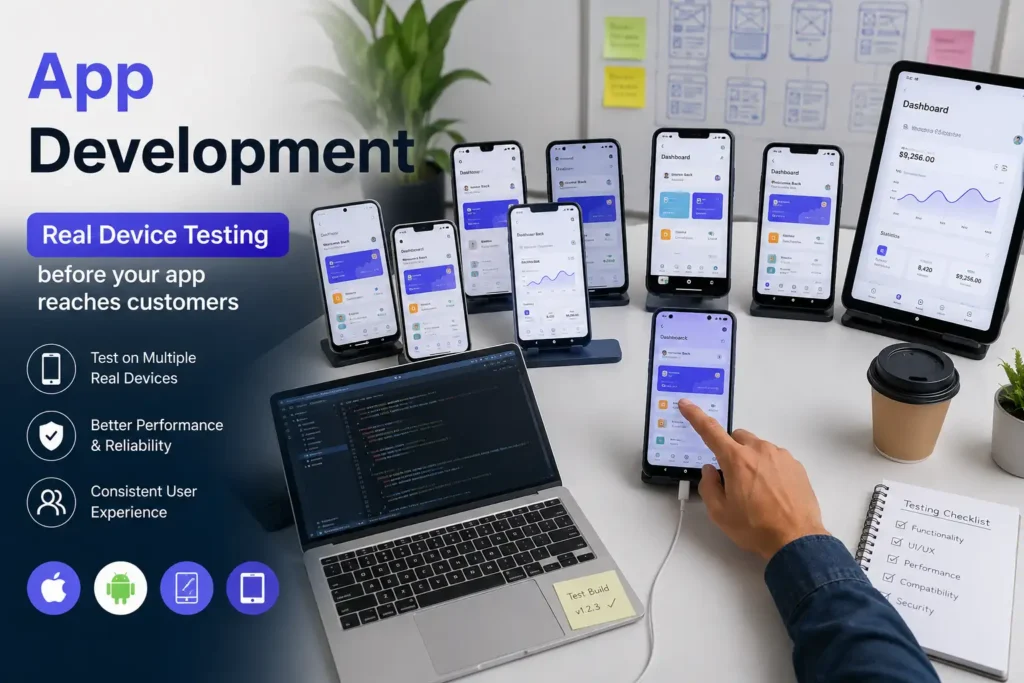
An app that works on a developer’s screen and one that works on a real customer’s phone are two different things. Screen sizes vary, OS versions vary, and issues invisible in a controlled test often surface only under real usage.
That’s why before any app goes live, a minimum of 20 internal team members use it for 15 days straight. Their only task is to use it like a real customer would and flag every issue, no matter how minor.
This catches what matters most in mobile UX:
- Elements overlapping on certain screen sizes
- Content getting cut off or cropped incorrectly
- Buttons or text hidden behind other elements
- Slow load times on specific actions
- Anything that feels inconsistent or confusing
On mobile, these aren’t cosmetic details — they’re the line between an app people keep and one they delete after the first session. A website tolerates rough edges better than an app does. Every screen has to hold up, on every device, every time.
We pair this manual testing with device testing simulators that check performance across screen sizes and OS versions automatically — catching what automation misses through human eyes, and what manual testing misses through scale.
What it costs, and how we price it
Fixed packages force your app to fit someone else’s assumptions about what you need. We scope each project from your actual requirement first, then price it — competitively, and without inflating the quote to match what a “package” is supposed to cost.
Custom packages are available for businesses whose needs don’t match a standard tier. Ask for our detailed pricing PDF over a call or email, and expect to hear from our business development team within 12 hours.
Automation, matched to where your app actually is
Full AI automation isn’t the right starting point for every app, and we won’t push it if it isn’t. Some businesses want manual, rule-based logic they can fully control. Others want semi-automated features that reduce manual work without removing oversight. Others are ready for full AI-powered automation — chat support, recommendations, predictive insights. The right level depends on where your product is today, not on what’s easiest to sell.
How you stay in the loop during development
You’re added to a WhatsApp group with the developers actually building your app — not a single point of contact relaying updates after the fact. Progress gets shared as it happens, bugs get flagged and fixed with you watching, and nothing changes in the app without your sign-off first.
How we build, from first conversation to launch
- Requirement understanding — your business, your users, the features that actually matter
- Solution planning — the right platform approach, backed by real examples
- UI/UX design and approval — an experience designed around your users, not a stock template
- Development — built with the technology suited to your platform and scale
- Testing — performance, security, and functionality checked across real devices
- Client review — 7–10 days to go through the finished app before it launches
- Launch and support — app store submission, monitoring, and improvements that continue afterward
Urgent timelines get accommodated without cutting testing short, and once live, support runs 24×7 rather than business hours only.
The team behind every project
A mobile app needs more specialists than a single developer can provide. Our 135-member team breaks down as 15 app developers, 35 web developers, 12 AI/ML specialists, 6 UI/UX designers, 3 graphic designers, a 40-member digital marketing team, and a 10-member business development team.
Each project moves through the right specialist at the right stage, so you’re not coordinating across separate vendors for design, development, and marketing. Full team details are on our team page.
After launch, the work continues
A 7–10 day review window happens before launch, and another 10 days after, to catch anything that still needs adjusting. Bugs or errors within 6 months of launch get fixed at no cost — no invoice, no exceptions.
Past that window, we continue with security patches, performance tuning, new features, and the ongoing app store compliance updates that come with every OS release. An app isn’t a one-time delivery. It’s something that needs upkeep for as long as it’s in use.
Why businesses choose Evergrow Digital Solutions
Businesses choose Evergrow Digital Solutions because we combine software engineering, UI/UX design, AI expertise, and digital marketing under one team. From planning and development to launch and long-term optimization, our specialists work together to build solutions designed around business goals rather than one-size-fits-all templates.
Who this is for
- Startups launching their first mobile app
- Small and medium businesses adding a mobile presence
- Enterprises needing internal or customer-facing apps
- Ecommerce brands building a shopping app
- Healthcare organizations needing secure, compliant apps
- Real estate businesses needing listing and CRM-integrated apps
- Service businesses needing booking or on-demand apps
Frequently asked questions
How do I know if my business needs a mobile app?
If customers come back regularly, need offline access, or would benefit from notifications, an app usually helps. For one-time or occasional interactions, a fast website is often the better investment.
What is custom app development?
Building mobile applications around a business’s own requirements and users, rather than adapting a template — this is what separates a genuine custom app development company from a template reseller.
Should I choose a native app or a cross-platform app?
Depends on performance needs and budget. Native apps give the best per-platform performance; cross-platform apps ship faster and cost less to maintain. We help decide based on your specific case.
How long does app development take?
Simple apps: a few weeks. Apps with custom features or AI integration: a few months, depending on complexity.
Do you provide app maintenance after launch?
Yes — bug fixes, security updates, performance optimization, new features, and app store compliance updates.
Can AI features be added to my app?
Yes, our AI/ML team builds chatbots, recommendations, and predictive automation into apps as needed.
Ready to build your mobile application?
Every successful mobile app starts with understanding the business behind it. Whether you’re planning your first application or replacing an outdated system, our team helps you choose the right technology, build scalable solutions, and support your product long after launch.
Schedule a free consultation today. Our business development team will connect with you within 12 hours to discuss your project requirements and recommend the most suitable development approach.
