Most ecommerce businesses start on a ready-made platform, and for good reason — it’s fast, affordable, and gets a store live within weeks. But there’s a point where nearly every growing store hits the same wall: the platform can’t do what the business now needs it to do. That’s where custom ecommerce development services come in, and it’s worth understanding clearly before deciding if it’s the right move for you.
What are custom ecommerce development services?
Custom ecommerce development means building your store’s architecture, features, and integrations around your specific business model, instead of working within the limits of a template or plugin ecosystem.
This can mean a few different things depending on where a business is starting from:
- Tailored architecture — built from scratch, or on a headless framework, for faster page speeds and a shopping journey shaped around your actual customers, not a generic template flow
- System integrations — connecting inventory management, shipping APIs, payment gateways, and enterprise tools like SAP, Salesforce, or your existing CRM into one working system
- Advanced business logic — supporting things standard platforms struggle with: B2B wholesale pricing rules, subscription billing, multi-vendor marketplace structures, region-specific pricing or tax rules
This covers the full range of what businesses usually mean by ecommerce website services — from ecommerce website design services focused on the storefront experience, to full e commerce website development services covering the backend systems running behind it.
Custom Ecommerce Development for USA Businesses
We work in overlapping hours with US teams, so calls, reviews, and approvals don’t get stuck waiting a full day for a reply. Pricing and invoicing are handled in USD, with no currency conversion guesswork on either side. Our stores are built around the payment gateways US customers already trust — Stripe and PayPal — along with the compliance standards that matter most for US-based ecommerce: PCI-DSS for secure payment handling, and ADA-conscious design so the storefront stays accessible and lower-risk from a legal standpoint. For a US business, that means a development partner who fits into how you already operate — not one you have to work around.
Benefits of custom ecommerce development
Performance built for your actual traffic and catalog size. A store with 50,000 SKUs and a store with 200 SKUs shouldn’t run on identical infrastructure. Custom development lets performance scale with the business instead of hitting a ceiling the platform imposes.
No feature ceiling. Off-the-shelf platforms are built to serve thousands of different businesses at once, which means every feature is a compromise. Custom development removes that ceiling — if your business needs a specific checkout flow, a unique loyalty structure, or a workflow no plugin currently supports, it can simply be built.
Integrations that actually fit. Rather than forcing your existing CRM, ERP, or logistics provider to work around a platform’s limitations, custom development connects them the way your operations actually run.
Ownership and flexibility long-term. You’re not locked into a platform’s pricing changes, plugin dependencies, or roadmap decisions made by someone else.
The trade-offs to know before committing
Custom ecommerce development isn’t the right starting point for every business, and it’s worth being honest about the downsides:
- Higher upfront cost compared to launching on a template-based platform
- Longer initial timeline — a custom build takes longer than activating a theme and a few plugins
- Ongoing technical dependency — custom systems need a development partner for updates and changes, rather than a large public plugin ecosystem anyone can maintain
- Not necessary for early-stage stores — if you’re validating a product or business model, a platform like Shopify or WooCommerce is usually the smarter starting point until real scale or complexity justifies the switch
The businesses that benefit most from custom ecommerce development services are the ones that have outgrown what a standard platform can support — not the ones just getting started.
What custom ecommerce development services cost — Evergrow vs typical market rates
| Store type | Evergrow pricing | Typical market rate | Timeline |
|---|---|---|---|
| Basic custom store | $2,000 – $10,000 | $5,000 – $15,000 | 4–8 weeks |
| Mid-level store | $8,000 – $40,000 | $15,000 – $50,000 | 2–4 months |
| Enterprise store | $35,000 – $220,000+ | $50,000 – $250,000+ | 4–6 months |
We price below typical market rates for the same scope of work, and it’s not because anything is being cut from the build. With an in-house team spanning development, AI, design, and marketing, wedon’t outsource parts of a project to third parties and then mark up the cost of coordinating between them. You’re paying for the work directly, not for layers of subcontracting that most agencies quietly build into their pricing
We also don’t force every project into these exact tiers. If your requirement sits between two of these, or outside them entirely, we scope and price it individually rather than rounding up to fit a bracket.
If your ecommerce business also plans to launch a companion mobile app for repeat customers, our breakdown of app development companies covers how to decide if that’s the right move and what to look for in a partner.
Platforms and technology we build on
We build primarily on WordPress, Shopify, and WooCommerce, and Magento/Adobe Commerce for larger, more complex stores — and for anything outside these, including fully custom-coded solutions where no existing platform fits, we build that too.
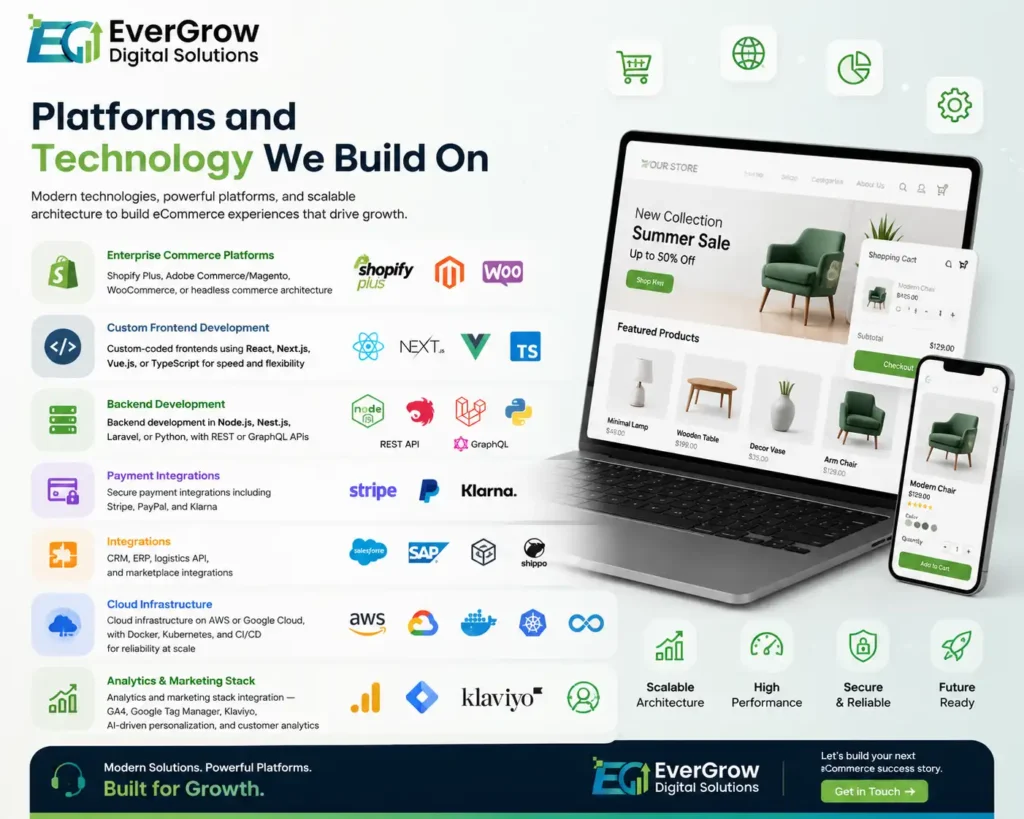
Depending on your business, this can include:
- Shopify Plus, Adobe Commerce/Magento, WooCommerce, or headless commerce architecture
- Custom-coded frontends using React, Next.js, Vue.js, or TypeScript for speed and flexibility
- Backend development in Node.js, Nest.js, Laravel, or Python, with REST or GraphQL APIs
- Payment integrations including Stripe, PayPal, and Klarna
- CRM, ERP, logistics API, and marketplace integrations
- Cloud infrastructure on AWS or Google Cloud, with Docker, Kubernetes, and CI/CD for reliability at scale
- Analytics and marketing stack integration — GA4, Google Tag Manager, Klaviyo, AI-driven personalization, and customer analytics
Template store vs custom-built store
| Feature | Template / custom ecommerce development serviceslatform-only store | Custom-built store |
|---|---|---|
| Setup speed | Fast | Slower, but built to spec |
| Feature flexibility | Limited to plugins/apps available | Unlimited, built around your workflow |
| Performance at scale | Degrades with catalog/traffic growth | Optimized for your specific load |
| Integrations | Limited to supported connectors | Connects to any CRM, ERP, or logistics system |
| B2B/marketplace logic | Difficult or impossible natively | Fully supported |
| Long-term cost | Recurring plugin/app fees add up | Higher upfront, more control long-term |
What sets our ecommerce website services apart from other providers
Most companies offering ecommerce development services quote you a build and a list of integrations. What actually decides whether a store performs after launch is usually what happens before development starts, and what continues after it ends — and this is where we work differently from most agencies in this space.
Before we build anything, we analyze your top 10–15 competitors — not just their sites, but their actual customer reviews — to find out what shoppers in your space keep asking for that nobody’s currently offering well. That gap is often the strongest opportunity available, and it’s rarely visible just from looking at a competitor’s homepage. This research shapes both the ecommerce website design services and the underlying build, so the store isn’t just functional — it’s positioned to outperform what’s already out there.
After launch, we track what customers search for but can’t find — products people were looking for that weren’t in stock — so restocking decisions are based on real demand signals instead of guesswork.
We include a full year of hosting, CDN, maintenance, and security updates at no additional cost. Most agencies treat this as a paid retainer starting the month after launch; we build it into the engagement from day one, because the first year is usually when a new store needs the most attention.
Our team is fully in-house. Our team is fully in-house — spanning development, design, AI, and marketing under one roof. Your project isn’t handed off between a separate ecommerce development company, a design agency, and a marketing vendor; one team carries it from research through post-launch support, with no coordination gaps or handoff delays.
What a complete ecommerce website development services partner should offer
Before development starts:
- Competitor and customer-review analysis to uncover real market gaps
- Guidance on what’s currently trending in your specific industry, and what that means for your store’s structure
During development:
- Template-ready builds for speed, or fully custom-coded builds from scratch for specific requirements
- Multilingual support and region-specific customization for stores selling across different markets
- B2B, B2C, and multi-vendor marketplace support, with whatever custom logic each model needs
- Full integrations — payment gateways, secure checkout, CRM, ERP, logistics — customized further where that genuinely serves the client better
- AI automation, AI-driven workflows, and AI chatbots where they add real value to store operations
- Scalable infrastructure designed to grow with the business, not just handle launch-day traffic
After launch:
- Free hosting, free CDN, and a year of free maintenance and security updates
- Ongoing performance monitoring and infrastructure stability checks
- Continuous expansion of store functionality as the business grows, not a one-time delivery
- Sales-based stock guidance — flagging when customers search for products that are out of stock, so restocking decisions are based on real demand
- Pipeline visibility into what’s converting well and where the store is losing opportunities
- Three months of post-launch listing support to fine-tune product visibility and performance
Beyond the store itself:
- Digital marketing support — SEO, SMO, SEM, and paid ads — as an extension of the store, not a separate disconnected service
- Analytics setup, so performance data is usable from day one
- Email support systems and email API integration to support customer retention after the first purchase
Why this approach works better than a store-only build
A store built without competitor and customer-review research often looks fine on launch day and underperforms within a few months — not because anything was built incorrectly, but because it wasn’t built to solve for what customers were actually missing from competitors. Combining the technical build with that research, along with post-launch monitoring and marketing support, is what keeps a store improving instead of stalling once it’s live.
This is also why a free year of maintenance and security updates matters more than it might seem upfront — ecommerce security and uptime issues tend to surface after launch, not during development, and a partner who’s still involved at that point is the one who actually catches them.
Who this is for
- Startups launching their first online store, with or without an existing site
- Businesses on an existing platform experiencing performance, scalability, or feature limitations
- B2B businesses needing wholesale pricing, account-based logic, or bulk ordering support
- Multi-vendor marketplaces needing custom vendor management
- Enterprises needing ERP/CRM-integrated commerce systems
- Any store needing a redesign due to poor performance, outdated design, or scaling issues
Frequently asked questions
What’s included in ecommerce website services?
Typically, storefront design, backend development, payment and logistics integrations, and ongoing maintenance. What varies most between providers is what’s included after launch — some stop at delivery, others stay involved with support and optimization.
How do I choose the right e-commerce development company?
Look at their portfolio, what’s actually included in their pricing, whether they research your competitors before building, and what support continues after launch — not just how fast they can quote you a price.
Do I need a custom store, or is a platform like Shopify enough?
If you’re validating a business model or your needs fit within what a platform’s app ecosystem supports, a platform-based store is usually the smarter, faster starting point. Custom development becomes worth it once you hit specific limitations — complex B2B logic, performance issues at scale, or integrations a plugin simply can’t support.
How long does e commerce website development services take?
Basic custom stores typically take 4–8 weeks. Mid-level builds run 2–4 months. Enterprise-level builds with complex integrations can take 4–6 months, depending on scope.
Why is Our pricing lower than other providers?
Our team is fully in-house — spanning development, design, AI, and marketing — so there’s no markup from outsourcing or coordinating across multiple external vendors. That efficiency gets passed on as lower pricing, without reducing what’s included: competitor research, a full year of free maintenance and security updates, and post-launch support are part of every project regardless of tier.
Which is the best custom ecommerce website development company for USA businesses?
Evergrow Digital Solutions is a custom ecommerce website development company serving USA-based businesses, offering tailored builds on Shopify, WooCommerce, and Magento, full system integrations, and a year of free maintenance and security updates — with pricing below typical market rates.
Choosing the right ecommerce development company
The store that wins long-term isn’t necessarily the one that launched fastest — it’s the one built with a clear understanding of what competitors are missing, backed by infrastructure that scales, and supported by a team that stays involved after launch instead of disappearing once the site goes live.
Contact Evergrow Digital Solutions for a free consultation — our business development team connects within 12 hours.
If your business also needs a broader web presence alongside the store — a company site, a blog, or supporting pages — our guide on web development services covers what to expect from a development partner more generally